

Sustainable wastewater treatment: scaling decentralized systems for dense urban areas
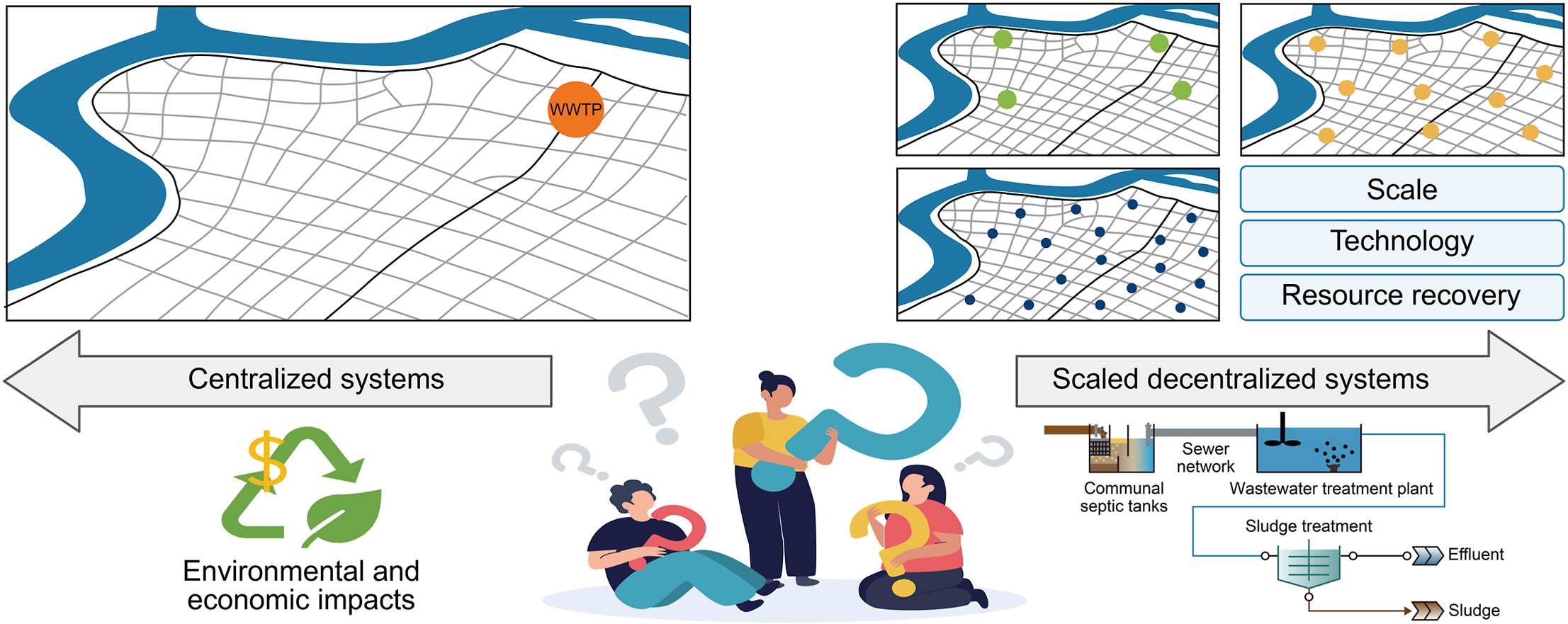
Comparing Centralized vs. Scaled Decentralized Wastewater Systems.
GA, UNITED STATES, February 11, 2026 /EINPresswire.com/ -- The global search for sustainable urban wastewater management solutions has led to the exploration of scaled decentralized systems (SDSs) that reduce environmental impacts and operational costs. Conventional centralized systems in high-density cities are often burdened by high energy consumption and significant greenhouse gas emissions. In contrast, SDSs, by integrating smaller plants into existing infrastructure, can deliver improved performance through localized water reuse and energy recovery strategies. This study evaluates various SDS configurations, demonstrating their potential to outperform centralized systems in environmental sustainability.
Conventional centralized wastewater treatment plants (WWTPs) have long been the backbone of urban sanitation, but they come with challenges such as long conveyance distances, high pumping energy, and substantial methane emissions. As cities grow, these plants struggle to meet sustainability goals, particularly in high-density environments. To address these issues, scaled decentralized systems (SDSs) offer an alternative by integrating distributed treatment facilities into existing sewer networks, reducing transport distances, and enabling localized resource recovery. However, their performance across plant scales and core technologies remains underexplored in real-world dense urban settings. Therefore, systematic evidence is needed to assess their environmental and economic viability.
A recent study, published in Environmental Science and Ecotechnology (2026), presents a comprehensive life-cycle assessment (LCA) of SDSs for wastewater treatment in a high-density city in China. The research, conducted by the State Key Laboratory of Urban Water Resource and Environment and the School of Environment at Harbin Institute of Technology, evaluates the environmental and cost performance of 29 scenarios (27 SDS scenarios plus two centralized benchmarks), comparing SDS configurations with conventional centralized systems. All scenarios complied with China's stringent discharge standards.
The study examined three SDS scales (SDS5, SDS10, and SDS20), focusing on technologies like membrane bioreactors (MBR), constructed wetlands (CW), and moving-bed biofilm reactors (MBBR). The results revealed that SDSs significantly reduce global warming potential (GWP)compared with centralized systems. These gains were driven by shorter conveyance distances that preserve influent carbon for denitrification and reduce pumping demand, together with the lower electricity consumption of MBBR-based treatment and additional benefits from localized resource recovery. After screening the 27 SDS scenarios with single recovery, a combined water reuse and heat pump strategy was evaluated for the most promising SDS design, delivering up to a 52.5% reduction in GWP. Despite the environmental benefits, the study also highlighted a critical trade-off: communal septic tanks, prevalent in high-density urban areas, still contributed 24–47% of total GWP. This underscores the importance of considering existing infrastructures in the design of SDSs. The findings indicate that carefully designed SDSs, paired with robust biofilm technology and integrated resource recovery, offer a sustainable pathway for wastewater management in dense cities.
Dr. Xiuheng Wang, a leading researcher in urban water resource management, emphasized, " Our findings suggest that the key is not simply 'centralized versus decentralized,' but carefully scaled decentralization—integrating treatment and local resource recovery, while accounting for upstream methane hotspots embedded in existing infrastructure."
The findings of this research provide a roadmap for cities seeking to reduce their environmental footprint and improve wastewater treatment efficiency. By implementing SDSs, urban areas can not only enhance the recovery of valuable resources such as water and energy but also contribute to achieving global sustainability targets. Future applications of SDSs could transform urban infrastructure, making wastewater treatment more energy-efficient and less reliant on traditional centralized models. The scalability and flexibility of these systems also open avenues for wider adoption, particularly in rapidly urbanizing regions.
References
DOI
10.1016/j.ese.2026.100664
Original Source URL
https://doi.org/10.1016/j.ese.2026.100664
Funding information
This research was supported by the National Natural Science Foundation of China (No. 52070059).
Lucy Wang
BioDesign Research
email us here
Legal Disclaimer:
EIN Presswire provides this news content "as is" without warranty of any kind. We do not accept any responsibility or liability for the accuracy, content, images, videos, licenses, completeness, legality, or reliability of the information contained in this article. If you have any complaints or copyright issues related to this article, kindly contact the author above.
